
Queen Anthurium Care: The Ultimate 2026 Guide to Anthurium Warocqueanum
If you have spent any time in the rare aroid world, you already know that Queen Anthurium care is considered one of the most rewarding challenges in the hobby. Anthurium Warocqueanum — the Queen Anthurium — stands as one of the most coveted houseplants among rare plant collectors, captivating enthusiasts with its dramatically elongated, velvety leaves featuring striking white veins against a deep green background.
Get the care right and you will be rewarded with pendant leaves up to 4 feet long that no other houseplant can rival. Get it wrong and the Queen will tell you — loudly, through dropped leaves and declining velvet. A general rule for Queen Anthurium care: a happy plant will add new leaves to existing ones. Unhappy plants drop a leaf each time a new one develops. Your leaf count is your scorecard.
This is the most complete Queen Anthurium care guide available in 2026 — covering everything from its Colombian origins to ecotypes, full environmental requirements, common mistakes, propagation, and where to find a genuine specimen.
What Is the Queen Anthurium?
Anthurium Warocqueanum is native to the tropical rainforests of Colombia, where it thrives as an epiphyte or lithophyte in the humid, shaded understory — very rarely found growing in the ground.
It grows as a hemiepiphytic or epiphytic giant species in the undercanopy, ranging from sea level tropical rainforest all the way up to cloud forest ecosystems above 7,000 feet in western Colombia — discovered by Gustav Wallis in the late 19th century and formally described by Thomas Moore in 1878.
The species was named in honor of M. Warocqué — a Belgian horticulturist and influential patron of botanical sciences, during an era when Belgian botanists were among the earliest European collectors to encounter this extraordinary species.
Understanding its natural habitat is the foundation of correct Queen Anthurium care. Everything this plant needs — high humidity, filtered light, excellent airflow, near-perfect drainage — comes directly from the Colombian cloud forest environment it evolved in.
What Does the Queen Anthurium Look Like?
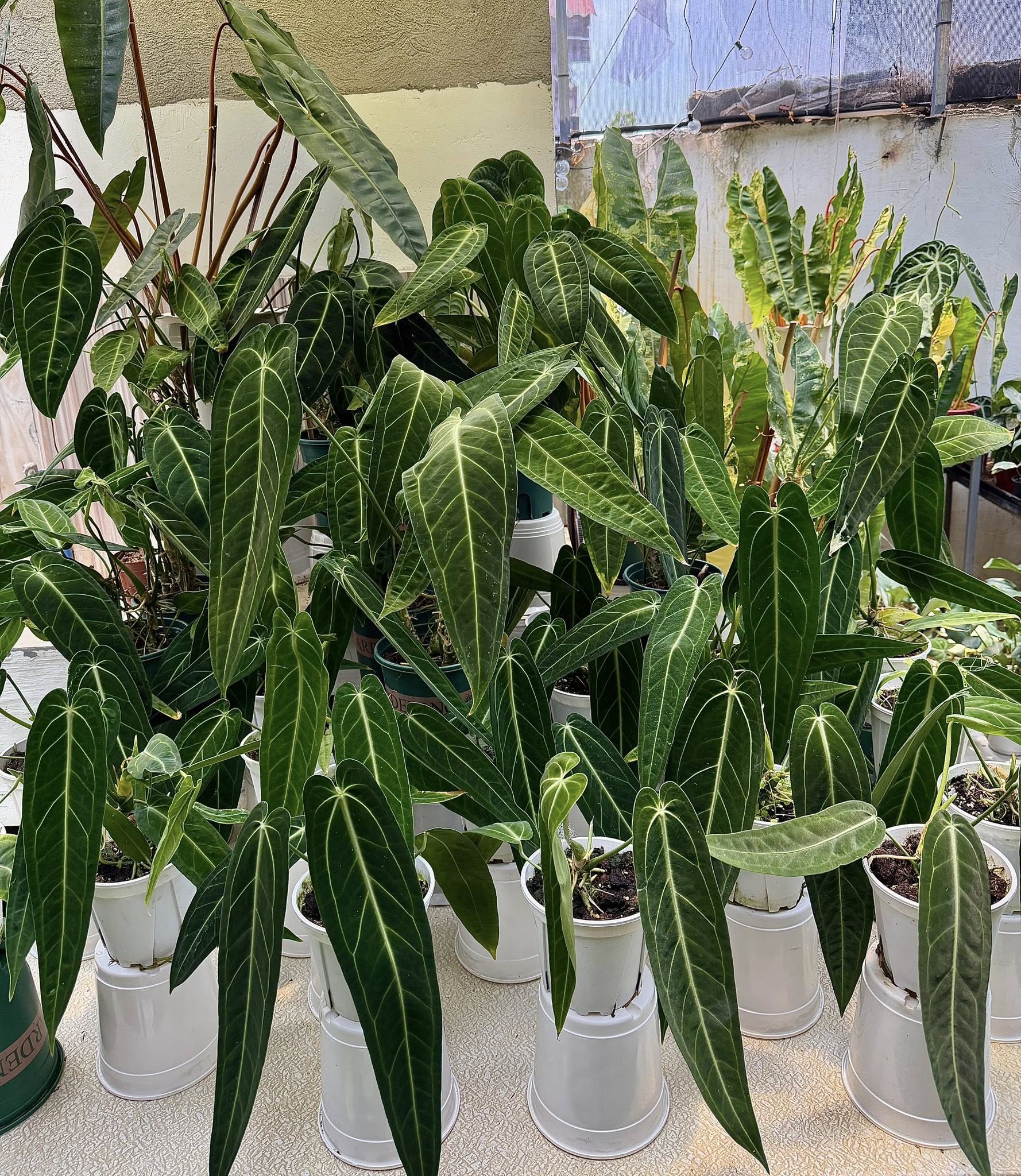
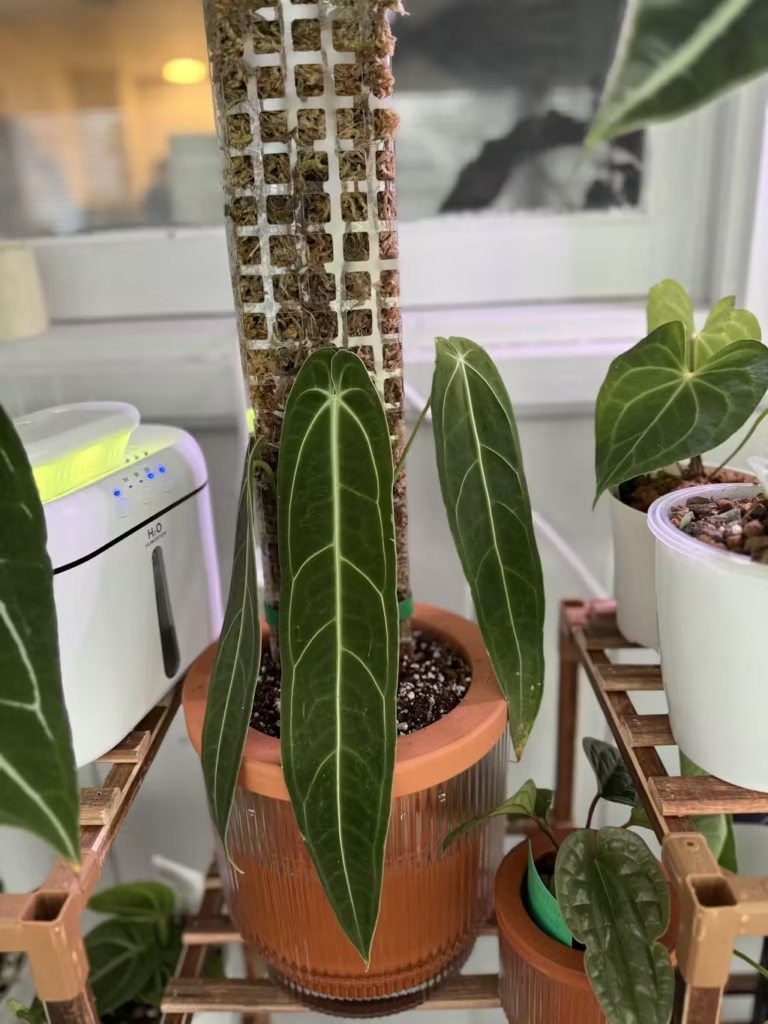
The leaves of Anthurium Warocqueanum are long, narrow, and have a velvety-soft texture that gives them a luxurious and unique appearance. The leaf surface is a deep dark green that can appear almost black depending on the light — interspersed with strongly contrasting white to silvery leaf veins that run symmetrically along the entire length of the leaf, giving the plant an almost sculptural effect.
Dense trichomes create the matte, soft velvet appearance that enhances visual depth — and under optimal Queen Anthurium care, leaves can reach 1.2–1.6 meters indoors.
As with Monsteras and other aroids, the Queen Anthurium has insignificant blooms that appear on a small spathe, usually hidden by a pale yellowish-green spadix. Given the proper conditions, the inflorescence gives way to small, light red berries that attract birds.
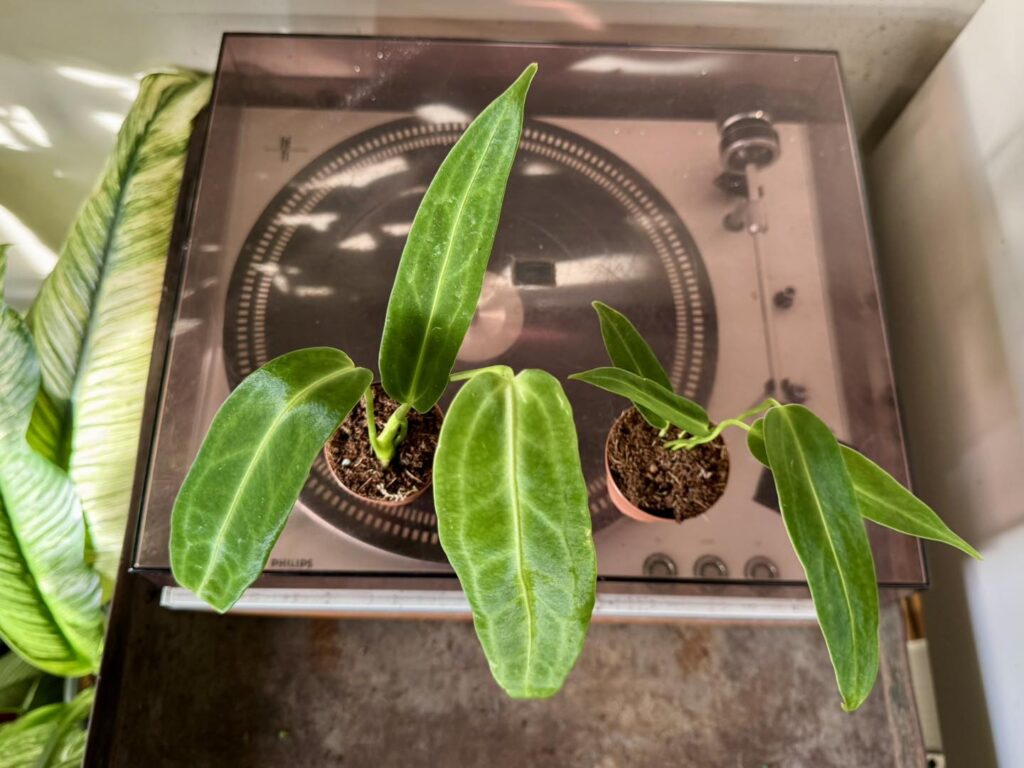
The Ecotypes — Why Not All Queen Anthuriums Look the Same
One of the most important things to understand about Queen Anthurium care and selection is that this is not a uniform species. Different populations from different parts of Colombia produce visibly different plants.
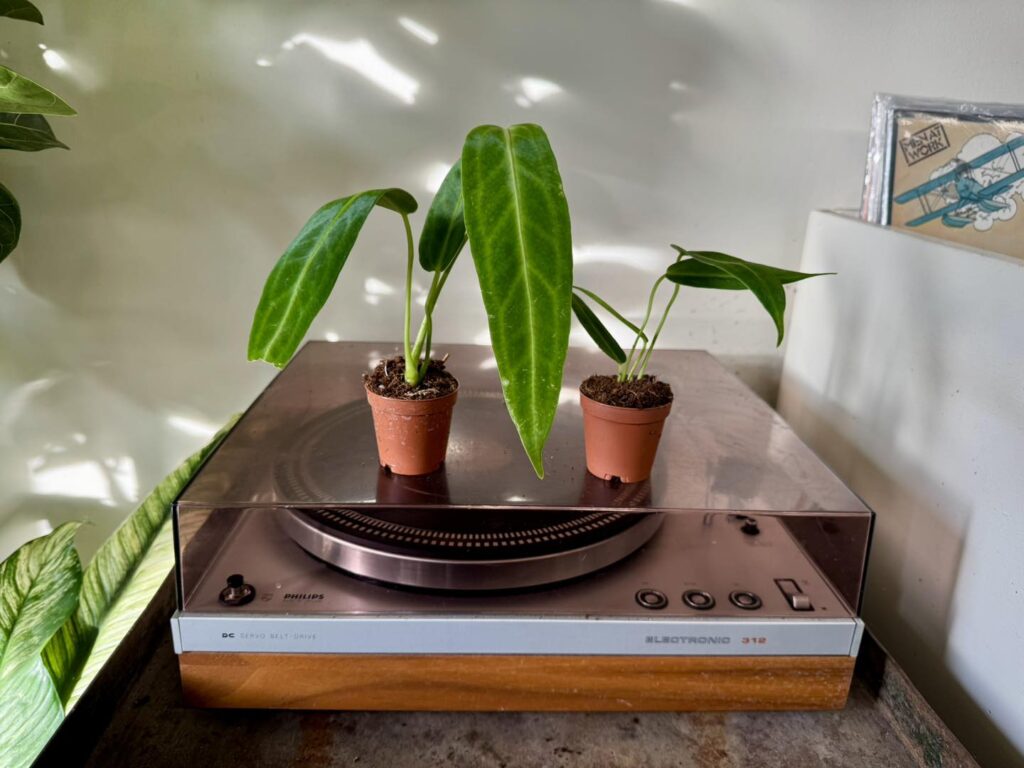
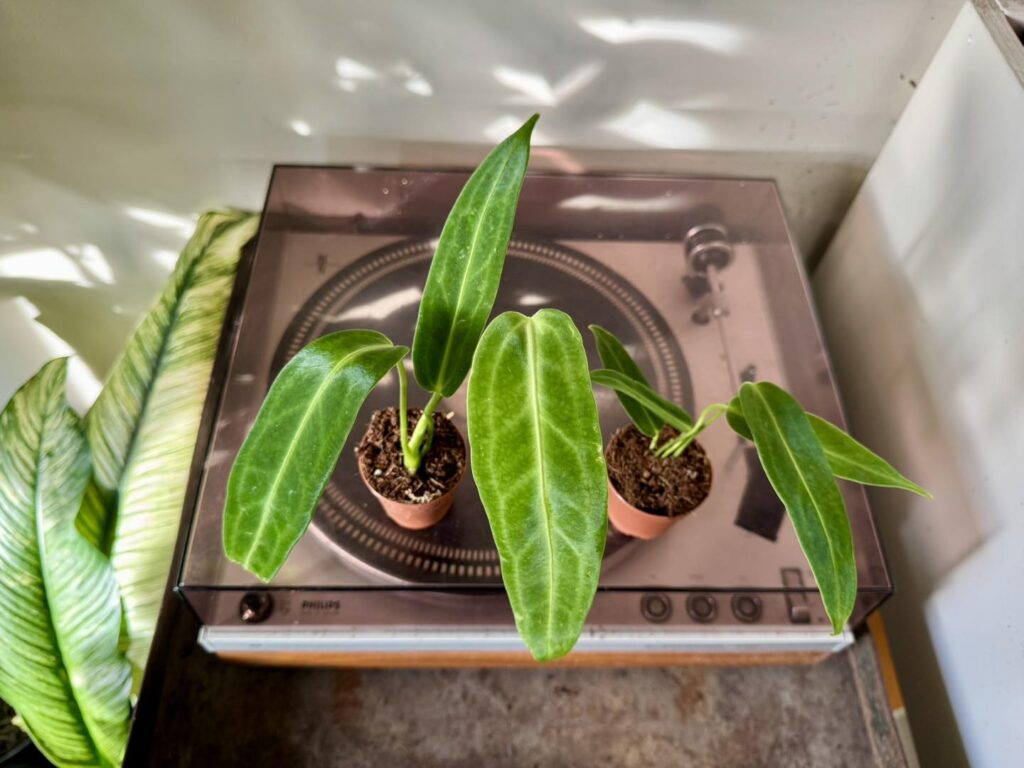
Depending on the climate, some plants have darker, more narrow leaves while others have wider, greener leaves. It is impossible to say with certainty in which ecotype plants grow in a certain way because leaf appearance can vary depending on conditions and age — but most Queen Anthuriums grow darker and have narrower leaves.
Several more or less recognizable ecotypes and local variants are worth collecting — especially plants with long, narrow, dark green leaves and a sparse number of leaf veins. The so-called “black warocqs” or “narrow dark woqs” reportedly originate from the lowlands of the Chocó and Valle del Cauca Departments and are among the most distinctive variants in the exotic plant trade.
For collectors, the narrow dark ecotype commands the highest prices and the most serious attention. If you see an Anthurium Warocqueanum with near-black, strap-like pendant leaves and crisp parallel silver veins — that is the crown jewel of Queen Anthurium ownership.
Queen Anthurium Care: The Complete Guide
Mastering Queen Anthurium care comes down to replicating — as closely as possible — the conditions of a Colombian cloud forest inside your home. Here is how to do that:
Light
Queen Anthurium care requires bright indirect light — the optimal range is 10,000–20,000 lux. The plant is sun-loving and naturally grows towards the light, but too much direct sun will scorch the leaves. For outdoor growing, a partially shaded spot is the safe choice.
East or north-facing windows work well indoors. Grow lights set to 12–14 hours are an excellent option for collectors in darker climates or during winter months. In lower light the Queen survives but produces smaller, less impressive leaves without the full dark velvet and silver vein contrast that makes it so extraordinary.
Watering
Watering is where most Queen Anthurium care mistakes happen. Top watering is recommended — pour water slowly around the base of the plant until it flows from the drainage holes, then allow all excess to drain completely. Never leave the pot sitting in standing water for extended periods.
Keep the soil lightly moist during the growing season (March–September), letting the top layer just approach dryness between waterings. In winter, reduce frequency significantly. A moisture meter takes the guesswork out of this entirely and is one of the best investments for Queen Anthurium care.
Humidity
Humidity of 70% or more is required for optimal Queen Anthurium care. This is non-negotiable. Below 60%, the velvety leaf surface of Anthurium Warocqueanum loses quality within weeks — tips brown, velvet fades, and spider mites appear rapidly.
Best humidity solutions for Queen Anthurium care:
- Plant cabinet — the gold standard, especially IKEA greenhouse cabinets with a small fan added
- Dedicated humidifier running continuously nearby
- Enclosed greenhouse shelf
- Terrarium setup for smaller or juvenile specimens
Crucially: good airflow alongside high humidity is essential — stagnant humid air encourages fungal disease. A small fan on low near the plant replicates the gentle airflow of the Colombian forest canopy and is a non-negotiable part of correct Queen Anthurium care.
Soil & Growing Medium
For Queen Anthurium care, 100% sphagnum moss or a chunky aroid mix of perlite, orchid bark, charcoal, peat moss, and potting mix delivers the best results.
Being naturally epiphytic, Anthurium Warocqueanum also thrives:
- Mounted on a cork board or tree fern plank — roots exposed to air, leaves hanging pendant freely — the most authentic growing method
- In a hanging basket — allows the pendant leaves to develop to full dramatic length
- Semi-hydro in LECA — gaining popularity among advanced collectors for consistent moisture control
Maintain soil pH between 6.6 to 7.5 — most macro and microelements the plant needs will be available in this range.
Temperature
Queen Anthurium care requires a temperature of 68–86°F (20–30°C). Stability is as important as the range — sudden temperature drops cause immediate stress and leaf drop in Anthurium Warocqueanum. Keep well away from cold drafts, air conditioning vents, and any position that drops below 60°F (15°C) at night.
Fertilizing
For Queen Anthurium care, fertilize weekly with liquid fertilizer at 1/4 of the recommended strength. Little and often is far more effective than infrequent heavy feeding, which risks root burn. Reduce to monthly in autumn and winter. A balanced NPK fertilizer or aroid-specific formula both work well.
Container & Potting
Container choice matters more for Queen Anthurium care than for almost any other houseplant — because the pendant leaves need space to develop their full dramatic length. Options:
- Tall standard pot — allows roots to establish while leaves hang freely over the sides
- Hanging basket — the most natural presentation, closely mimicking epiphytic growth
- Cork or tree fern mount — the most authentic method, produces the most dramatic pendant effect
- Nursery pot inside a decorative outer — practical and easy to manage
Always ensure the crown of Anthurium Warocqueanum sits at or above the growing medium. Crown rot from a buried, damp crown is one of the most common failures in Queen Anthurium care.
Queen Anthurium Care: Common Mistakes to Avoid
Overwatering — the most frequent cause of Queen Anthurium death. Always let the top layer of soil approach dryness before watering again. When in doubt, wait one more day.
Low humidity — below 60%, Anthurium Warocqueanum deteriorates visibly within weeks. A hygrometer next to your plant is essential equipment for serious Queen Anthurium care.
Cold exposure — even one cold night below 15°C can set the plant back significantly. Never place near windows that get cold drafts in winter.
Insufficient light — in too-low light the Queen produces small, pale, underwhelming leaves without the deep dark velvet and silver vein drama that makes this species extraordinary. More indirect light produces more dramatic results.
Potting too large — a pot much larger than the root ball retains excess moisture and dramatically increases root rot risk. Always size up gradually.
Ignoring airflow — high humidity without circulation is a fungal disease recipe. Always pair your humidifier with a small fan. This single adjustment resolves the majority of fungal issues in Queen Anthurium care.
Propagation
The best Queen Anthurium propagation method is via stem cutting — cut a mature stem of Anthurium Warocqueanum that has leaves on it. Each cutting needs at least one node and ideally one or two healthy leaves.
Root in moist sphagnum moss inside a humidity dome at 22–26°C (72–79°F) with consistent warmth and humidity above 80% throughout the rooting phase. Queen Anthurium cuttings take 6–10 weeks to establish — patience is essential. Resist checking roots too early, which disturbs developing tissue.
Prune mainly to remove diseased leaves — a badly damaged leaf may also be removed to encourage new growth, but never remove healthy green leaves unnecessarily. Every healthy leaf on Anthurium Warocqueanum represents significant energy investment by the plant.
Conservation
In its native Colombian cloud forests, Anthurium Warocqueanum has become increasingly rare due to habitat destruction and over-collection. While not officially listed as endangered, wild populations face significant pressure — making ethically propagated specimens particularly valuable in the horticultural trade.
Always buy Queen Anthurium from reputable specialist sellers like us who can confirm ethical propagation. Wild-collected specimens not only damage wild populations — they also arrive stressed, often diseased, and with a fraction of the survival rate of nursery-propagated plants.
Frequently Asked Questions
Is Queen Anthurium care suitable for beginners? Queen Anthurium care can be challenging — Anthurium Warocqueanum is notorious for its picky attitude toward light, temperature, and watering needs. It is best suited to collectors with experience growing velvet anthuriums or other demanding aroids. That said, with the right setup it is entirely achievable.
How do I know my Queen Anthurium is thriving? A happy plant will add new leaves to the existing ones — unhappy plants drop a leaf each time a new one develops. Leaf count should only ever go up with correct Queen Anthurium care.
What is the most important factor in Queen Anthurium care? Humidity. 70% or more is required for optimal Queen Anthurium care — and it must be combined with good airflow to prevent fungal disease. Every other aspect of care becomes much easier once humidity is consistently high.
How long can Anthurium Warocqueanum live? With proper care, Anthurium Warocqueanum can live for decades — specimens in botanical collections have survived 20+ years. This is a long-term relationship between plant and grower.
What is the difference between narrow and wide form Queen Anthurium? The narrow dark ecotype — sometimes called “black warocq” — originates from the lowlands of Colombia’s Chocó and Valle del Cauca Departments and is among the most distinctive and prized variants in the trade. Wide green forms are more common and slightly more forgiving in Queen Anthurium care.
Is Queen Anthurium toxic to pets? Yes — like all Anthuriums, Warocqueanum contains calcium oxalate crystals and is toxic to cats, dogs, and humans if ingested. Keep out of reach of children and animals at all times.
Ready to Own the Queen?
Now that you know everything about Queen Anthurium care, it is time to bring one home. At Variegated Plant Shop every Anthurium Warocqueanum is fully rooted, personally inspected, and shipped worldwide with protective packaging and climate packs included seasonally.
👉 Buy Anthurium Warocqueanum here 👉 Browse all rare velvet Anthuriums 👉 Read our guide to Anthurium Crystallinum x Magnificum