
The Rarest Cycad in the World: Encephalartos woodii
If you’ve ever asked what the rarest cycad in the world is, the answer is unambiguous: Encephalartos woodii, commonly known as Wood’s Cycad. It is extinct in the wild, reproduced only as clones, and has no known female specimen anywhere on Earth. There are an estimated 500 individuals in existence globally — and every single one is genetically identical.
This is not just the rarest cycad in the world. It is one of the rarest plants of any kind that a collector can legally own.
What Is Encephalartos woodii?
Encephalartos woodii belongs to the ancient family Zamiaceae and the genus Encephalartos — a group of cycads native exclusively to Africa. It is endemic to the oNgoye Forest of KwaZulu-Natal, South Africa, and holds the IUCN conservation status of Extinct in the Wild.
Cycads as a group are living fossils. They predate dinosaurs, having survived on Earth for over 280 million years. Encephalartos woodii is the crown jewel of this ancient lineage — a species that clings to existence entirely through human intervention and botanical dedication.
It may well be the loneliest plant in the world. And that loneliness is exactly what makes it the most coveted plant among serious collectors.
The Discovery of Wood’s Cycad
Botanist James Medley Wood was walking through the Ngoya Forest of Zululand in southern Africa when he stumbled upon what would become his most famous discovery — a single clump of a rare and ancient cycad that by 1908 shared its discoverer’s name: Encephalartos woodii.
The only known wild plants were a cluster of four stems of one plant, discovered by Wood in 1895 on a steep south-facing slope on the fringes of the oNgoye Forest in KwaZulu-Natal. The annual rainfall at the site ranges between 750–1,000 millimetres, with hot summers and mild winters.
What followed was a gradual rescue operation spanning decades:
- 1899 — A basal offset was removed and sent to Kew Gardens in England
- 1903 — Three offsets were collected and planted at the Durban Botanic Gardens
- 1905 — A specimen arrived at the National Botanic Gardens of Ireland in Glasnevin
- 1907 — Two of the larger stems were collected; by this point the original clump was deteriorating
- 1912 — Only one trunk remained in the wild, standing approximately 3 metres tall
- 1916 — The last wild trunk was removed and sent to the Government Botanist in Pretoria
- 1964 — That final wild trunk is thought to have died
While extinct in the wild, Encephalartos woodii specimens are now found in many botanical gardens, institutions and private collections around the world, with an estimated 500 individuals in existence — all clones of the original specimen. VIRIAR
Why Is There No Female Encephalartos woodii?
This is the question that haunts botanists and collectors alike. E. woodii is dioecious, meaning it has separate male and female plants — however, no female plant has ever been discovered.
Without a female, natural sexual reproduction is impossible. The species can only be propagated asexually through offsets (suckers) from the base of the trunk. This means the global population of E. woodii will never increase beyond what can be produced through clonal propagation — making each plant more precious than the last.
Some botanists have experimented with hybrid crosses — using E. woodii pollen to fertilize related female species like E. natalensis, E. transvenosus, E. ferox, and E. altensteinii. The resulting hybrids carry the genetic signature of E. woodiiand are highly valued in their own right, though they are not true woodii specimens.
The search for a wild female has never officially ended. Botanists continue to hope that somewhere in the forests of KwaZulu-Natal, a female specimen may yet be found.
What Does Encephalartos woodii Look Like?
Wood’s Cycad is not just rare — it is genuinely beautiful, with a commanding, architectural presence.
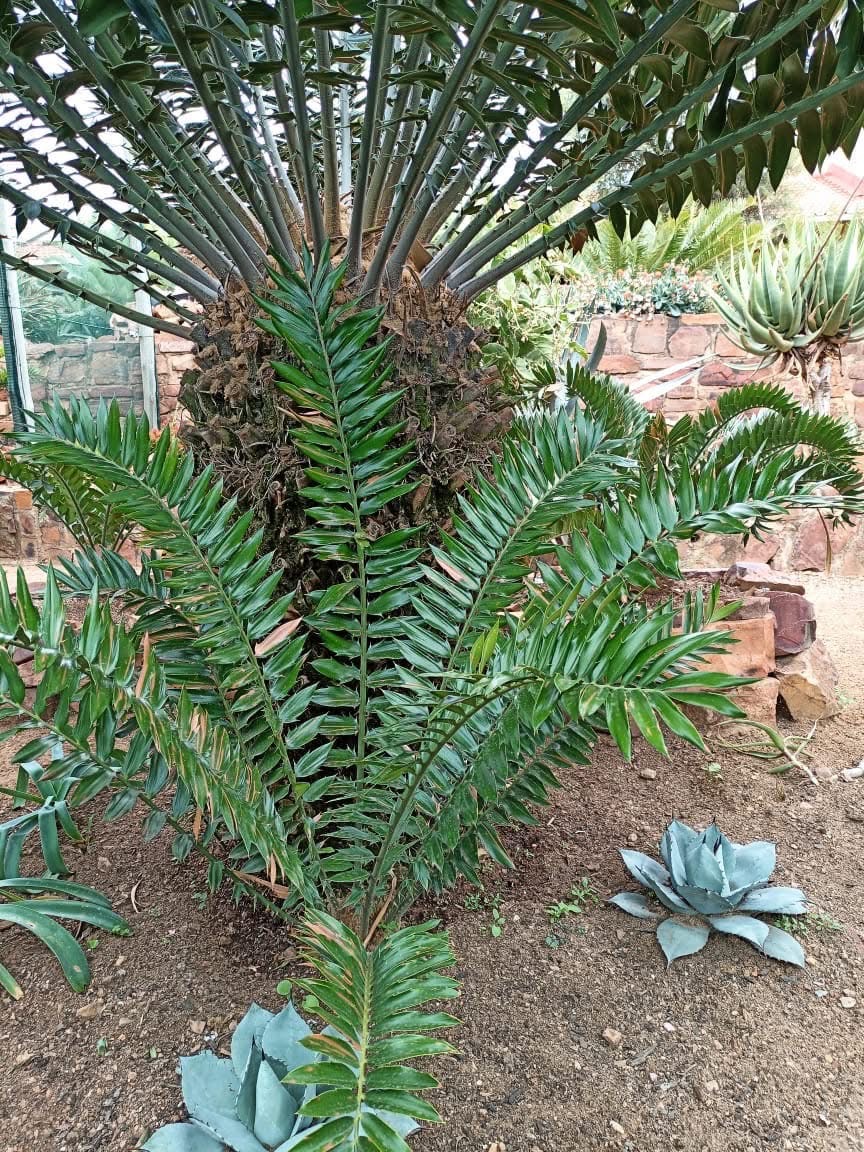
It can reach a height of 6 metres (20 feet). The trunk is about 30–50 centimetres in diameter, thickest at the bottom, and topped by a crown of 50–150 leaves. The leaves are glossy and dark green, 150–250 centimetres in length, with 70–150 sickle-shaped leaflets each measuring 13–15 centimetres long.
A characteristic unique to Encephalartos woodii is that in mature specimens the trunk broadens towards the base, forming a kind of buttress to support the weight of the trunk.
The male cones are cylindrical, 20–40 centimetres long — exceptionally up to 120 centimetres — and a vivid yellow-orange colour. A single plant may bear six to eight simultaneously.
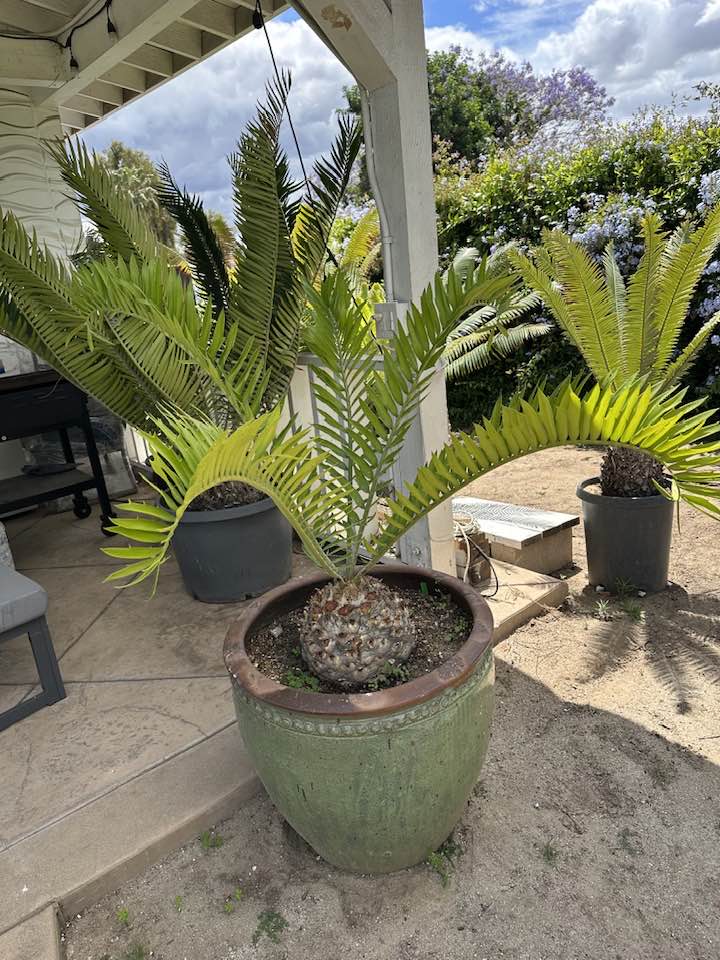
In cultivation, younger specimens have a compact, palm-like silhouette with arching dark green fronds that make them a commanding focal point in any garden or collection.
Encephalartos woodii Care Guide
Despite its legendary status, Wood’s Cycad is surprisingly manageable in cultivation. For an Encephalartos cycad, E. woodii is relatively fast-growing and vigorous in cultivation. VIRIAR
Here is everything you need to grow one successfully:
Light
Full sun is ideal. E. woodii thrives in direct sunlight and can tolerate partial shade, particularly when young. More sun encourages stronger, more upright frond growth.
Watering
Water moderately during the growing season (spring and summer), allowing the soil to dry between waterings. Once fully established, it becomes highly drought-tolerant. Never allow roots to sit in standing water — root rot is the main threat to young plants.
Soil
Use a well-draining sandy or rocky mix. A combination of coarse sand, perlite, and loamy soil works well. Good drainage is non-negotiable for long-term health.
Temperature & Climate
Best suited to hardiness zones 9–11. It tolerates mild frosts briefly but should be protected from prolonged cold. Outdoors year-round in warm climates; container growing is suitable for colder regions where it can be brought inside during winter.
Growth Rate
As with most cycads, growth is slow, pushing a new flush of leaves about once a year. Patience is essential — but the reward is a plant that will outlive you, and possibly your grandchildren.
Fertilizing
Feed with a slow-release fertilizer formulated for palms or cycads, applied in spring and summer. Avoid high-nitrogen fertilizers which encourage soft, vulnerable growth.
Container Growing
Excellent for large decorative containers. Use deep pots to accommodate the taproot, and ensure drainage holes are generous. Container specimens make extraordinary statement plants for patios, conservatories, and entrances.
Propagation
Only possible through offsets (basal suckers). When an offset appears at the base of the trunk, allow it to reach a reasonable size before removing. Let the cut end callous for several days before potting into gritty, dry mix. Keep dry initially to encourage root development rather than rot.
Where Are the Famous Encephalartos woodii Specimens?
Several of the world’s most important botanical institutions hold specimens descended directly from the original wild plant:
- Durban Botanic Gardens, South Africa — Home to two of the original trunks collected by James Wylie in 1907
- Kew Gardens, England — Has held a specimen since 1899; one of the oldest living cultivated cycads in the world
- Kirstenbosch, Cape Town — Received a sucker from the Durban plant in 1916
- National Botanic Gardens of Ireland, Glasnevin — Has held a specimen since 1905
- San Diego Zoo, USA — Considered among the rarest plant species in the world; their specimen stands about six feet tall despite the slow growth rate of the species
Each of these plants is considered a living national treasure and is kept under close security.
Is It Legal to Buy Encephalartos woodii?
Yes — with the correct documentation. Encephalartos woodii is listed under CITES Appendix I, which means international trade is permitted only with proper permits. Required documentation typically includes:
- CITES permit (export and import)
- Phytosanitary certificate
- Export/import permit
- Customs declaration
This sounds complex, but reputable sellers handle all of this on your behalf. At Variegated Plant Shop, our technical team manages every document for every international shipment — you simply receive your plant.
How Much Does Encephalartos woodii Cost?
Pricing reflects the plant’s rarity, documentation requirements, and the years of cultivation involved. Plants of this species sell for thousands of dollars — and for serious collectors, the investment is considered entirely justified. A well-cared-for specimen appreciates in value over time and can become a significant botanical asset. International Plant Names Index
Why Collectors Call It the Holy Grail
This is the Holy Grail for cycad collectors. That description has stuck for good reason. Owning an Encephalartos woodiimeans:
- Holding a piece of living evolutionary history
- Owning a plant that no longer exists in the wild
- Possessing something with genuine global scarcity — only ~500 in existence
- Contributing to the conservation of a species that depends entirely on human care to survive
No other plant offers this combination of beauty, history, rarity, and significance.
Frequently Asked Questions
Is Encephalartos woodii truly extinct in the wild? Yes. The last known wild trunk was removed in 1916 and thought to have died in 1964. No wild specimens exist today.
Can Encephalartos woodii reproduce sexually? No. No female has ever been found, so natural seed production is impossible. All propagation is through asexual offsets.
How many Encephalartos woodii exist in the world? Approximately 500, spread across botanical gardens and private collections globally — all clones of the one original plant.
How long does Encephalartos woodii live? Cycads are among the longest-lived plants on Earth. Specimens can survive for several hundred years under the right conditions.
Can I grow Encephalartos woodii indoors? It can be grown in a very large container indoors if given sufficient bright light, but it thrives best outdoors in warm climates (zones 9–11).
What is the difference between Encephalartos woodii and a hybrid woodii? A true E. woodii is a direct clone (offset) of the original plant. A hybrid woodii is the result of E. woodii pollen used to fertilize another Encephalartos species — it carries woodii genetics but is not a true specimen.
Own the Rarest Cycad in the World
If you are serious about rare plant collecting, Encephalartos woodii belongs in your collection. We ship worldwide with full CITES documentation, phytosanitary certificates, and hands-on guidance from our technical team at every step.
👉 Buy Encephalartos woodii here 👉 Browse all rare Encephalartos cycads